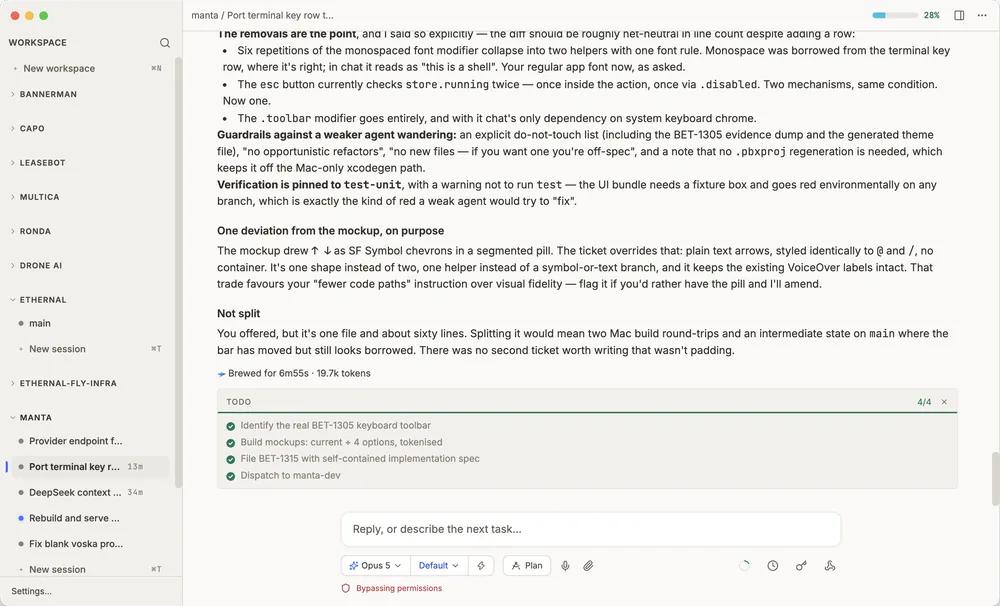
Manta puts Claude Code, Codex and opencode on a Linux box or Mac you own: your existing subscriptions, running side by side, reachable from your desktop and your phone. Setup takes two minutes.
Claude Max, ChatGPT Pro, Kimi: logged in once on the server and running side by side, in one searchable place.
A VPS, a spare Mac mini, a home server. Your code, your keys and every transcript stay on the box. Nothing routes through us.
Client and server, every line readable on GitHub. No account to create and no hosted tier waiting to upsell you. Telemetry is optional: the box sends nothing unless you set a token.
Point the app at a server, it installs itself and hands you a six-digit code. Type the code on your phone and you are done.
No terminal, no keys to copy, no tunnel to configure, no ports to forward. The desktop app does the whole install over SSH.
Pick a machine from your SSH config, or type a host. Any always-on Linux box or Apple Silicon Mac works.
Its own runtime, a system service, a certificate: no system packages touched. Ends with a six-digit code.
Log each agent CLI into the plan you already pay for, once. Every device you pair sees all of them.
Manta found these in your SSH config. It installs everything itself.
Everything below works the same on the desktop app, in a browser, and on the iPhone app.
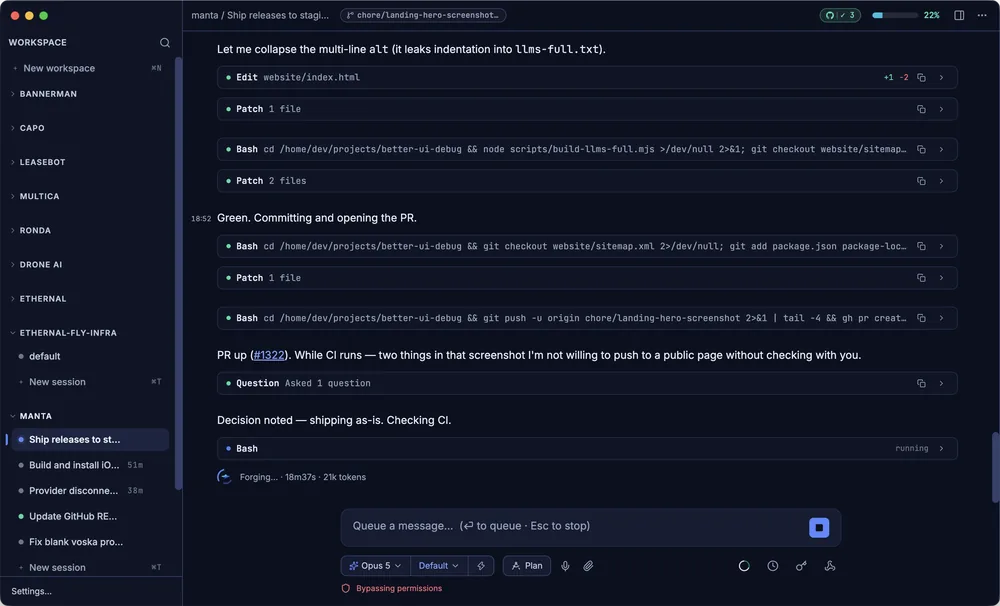
Diffs inline, tool calls collapsed, live command output as it streams. Not a terminal you have to squint at.
When an agent asks to run something, you get a button: on whichever device you happen to be holding.
Desktop while you are at the machine, phone push once you walk away. Never both, never for something you are watching.
Every session is a genuine tmux window. SSH in alongside Manta whenever you want; it is the same box.
Delegate long jobs to background agents, each in its own git worktree and branch. They never touch your checkout.
One query across the full history of every conversation on the box, whichever agent produced it.
Dictate a prompt, drag a file onto a session, paste a screenshot. It lands on the server, not in a cloud bucket.
Run a prompt on a cron, or let CI wake a session by webhook. Work that starts without you being there.
Hand an agent a token by reference, never by value. It uses the credential without it entering the transcript.
Manta is MIT licensed, client and server. There is no Manta account and no hosted tier. Telemetry is an optional log-shipper that sends nothing unless you set a token. Read the code, build it yourself, and run it with no connection to us at all.
Yes. You log each agent CLI into your own plan once on the server, and Manta runs them side by side. No Manta account, no proxy, no per-seat fee.
About two minutes. Point the desktop app at a server and it installs the runtime, starts the service, gets a certificate and shows a six-digit pairing code for your other devices.
Yes. Agents live in tmux sessions on the box as system services. Clients are disposable; close them all and the work continues, with full history when you reconnect.
Any always-on Linux box or Apple Silicon Mac. A five dollar VPS is enough. The installer touches no system packages and brings its own runtime.
No. Transcripts, uploads, secrets and config stay on the machine. The only outbound traffic is your agent talking to its own provider.
No. If Tailscale is already running, devices connect over your tailnet. If not, the box gets its own hostname and certificate. Either way, nothing to port-forward.
Yes: MIT licensed, client and server both. Read every line, build it yourself, run it with no connection to us. No account, no hosted tier. Telemetry is optional and sends nothing unless you set a token.
They overlap on a different bet. Those run agents on your Mac; Manta runs them on a server you own and gives every device the same window onto the work.
The desktop app sets the server up for you. If you would rather do it yourself, one command does the same thing.
Free, open source, and it runs on hardware you already own.
Download for macOS